GO BACK
How to Get the Most Out of Therapy: 8 Things to Do Between Sessions
Therapy usually takes about one hour a week. That leaves 167 other hours, and that's where most of


Therapy usually takes about one hour a week. That leaves 167 other hours, and that’s where most of life happens: the hard conversation at work, the bad night of sleep, the moment you notice an old pattern starting again.
What you do in those hours matters. A session is where you and your therapist spot something and plan what to try. The days between are where you actually try it. So if you want to get the most out of therapy, the biggest opportunity usually isn’t the hour itself; it’s the rest of the week. This guide covers simple, realistic ways to use that time, without turning your week into a second job.
Researchers have studied between-session work for decades. Several meta-analyses of cognitive and behavioral therapies have found that people who practice skills between sessions tend to improve more than people who don’t. Research on progress tracking points the same way: when therapists regularly see how clients are actually doing, fewer people get worse in treatment and more people recover, especially those who were struggling.
The takeaway isn’t that you need to do more. It’s that small, steady things you do between sessions, and a clear picture of how your week really went, help therapy work better.
Within an hour of your session, take two minutes to write down the one thing you most want to remember. It might be an insight (“I go quiet when I feel criticized”), a skill or a plan for the week. Memories of a session fade fast; a single sentence helps it stick.
If your therapist suggested something to try, make it as specific and small as you can. “Practice speaking up” is hard to start; “Say one thing I disagree with in Tuesday’s meeting” is doable. An if-then plan helps: “If I notice my chest tightening, then I’ll take five slow breaths before I reply.”
If you don’t have an assignment, ask your therapist at the end of the next session: “Is there something I could try this week?”
A daily check-in takes less than a minute. Rate your mood on a simple 1 to 5 scale and add a few words about what’s behind it. Doing this at about the same time each day makes your days easier to compare, and it means you don’t have to rely on memory when your therapist asks how your week was.
Alongside your mood, keep track of a few things that might affect it: sleep, movement, time outside, time with people, or anything your therapist has suggested. After a couple of weeks, patterns start to show, such as better days after a walk or harder evenings after short nights. Those patterns are some of the most useful things you can bring into a session.
Make the week between sessions count. Check in, track what helps, and see your patterns.
Hard moments rarely happen in the therapy room. When one comes, try a skill you’ve learned, such as slow breathing, a short grounding exercise (naming five things you can see, four you can hear, three you can touch) or stepping away for a few minutes. Afterward, jot down what happened and what you tried. Whether it helped or not, it’s worth talking about next time.
Thoughts worth discussing tend to show up at random times, and then disappear when you sit down for your session. Keep a note on your phone and add to it whenever something comes up: a reaction that surprised you, a question, a moment you’re proud of. Need ideas? See our list of 45 things to talk about in therapy.
The day before your appointment, spend five minutes looking at your check-ins, notes and list. Pick the one or two things that matter most. You’ll walk in with a clear starting point instead of trying to remember the last seven days on the spot.
You won’t do every step every week, and that’s fine. Missing a day or skipping a practice isn’t failure, and it’s useful to talk about too. What got in the way often says something important.
Some things shouldn’t wait for your next appointment. Contact your therapist, or another professional, if your symptoms are getting noticeably worse, you’re struggling to get through daily life, or something major has happened. Many therapists explain how to reach them between sessions; if yours hasn’t, it’s a good thing to ask.
If you’re in crisis or thinking about harming yourself, call or text 988 (Suicide & Crisis Lifeline) or call 911.
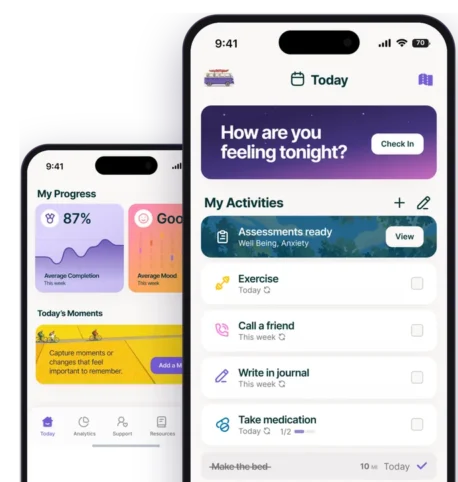
Healthy Mind Map is a free app built for exactly this part of therapy.
New to the app? Our Healthy Mind Map guide walks through each feature. For more tools, see the best mental health apps for people in therapy.
Get more from every session. Download Healthy Mind Map free.
Less than you might think. A daily one-minute check-in, one small practice and a quick look back before your session is plenty for most people. Steady and small beats ambitious and occasional.
You can still check in daily, notice patterns and keep a list of things to bring up. You can also ask your therapist whether there’s something specific you could practice.
It can be. Talking about painful things can leave you tired or stirred up for a day or so. If you feel worse for longer, or it keeps happening, tell your therapist; it’s useful information for both of you.
If something urgent comes up or your symptoms are getting worse, yes. Ask your therapist how they prefer to be contacted between sessions. In a crisis, call or text 988 or call 911.



Join Healthy Mind Map today. Your first step toward understanding your mental health.