GO BACK
10 Best Alternatives to Daylio for Mood and Mental Health Tracking
Daylio deserves credit for pioneering the two-tap mood log: pick an icon, tap a few activity tags, done
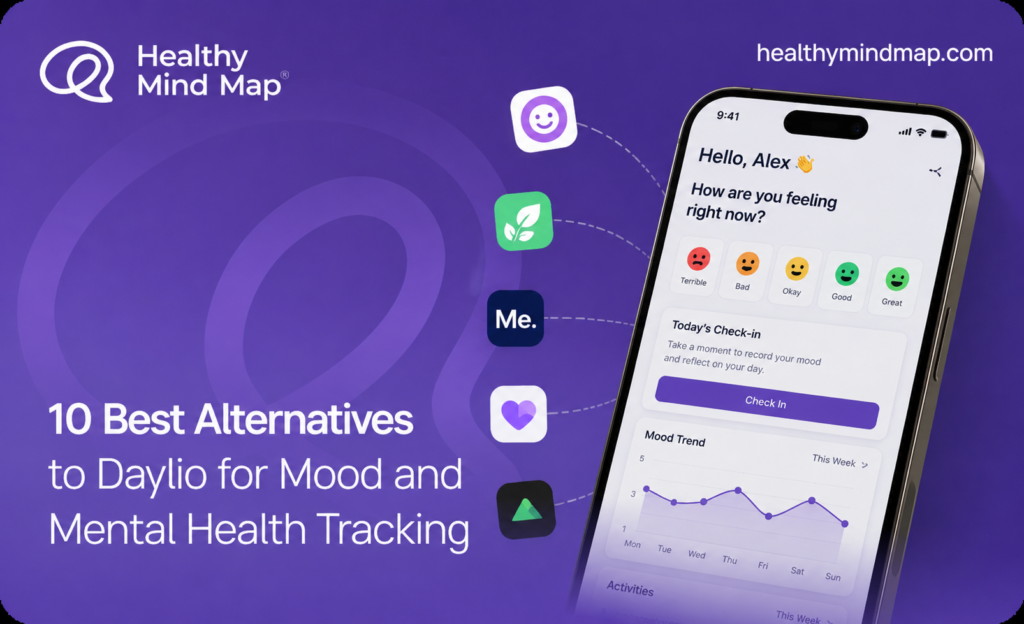


Daylio deserves credit for pioneering the two-tap mood log: pick an icon, tap a few activity tags, done in five seconds. That simplicity built a loyal following. But simplicity has a ceiling. Once you’ve been logging for a few months, a lot of people find themselves wanting more than a colorful heatmap they want to know why their mood dips every other Sunday, they want to loop in a therapist or a partner, or they want the app to actually connect their mood to their sleep and activity instead of just displaying it next to it.
If that’s where you’ve landed, you’re not alone it’s the single most common reason people search for a Daylio alternative. We compared the strongest options built to fill exactly that gap, and Healthy Mind Map leads the list for going further than mood logging alone: it connects tracking, structured assessments, biometrics, and a support circle into one coherent picture of your mental health.
Across the research for this guide, the same handful of limitations came up again and again: a shallow mood vocabulary (typically five levels), no clinical assessments, no medication tracking, and no built-in way to loop in a therapist or trusted person beyond exporting a spreadsheet yourself. None of that makes Daylio a bad app it does one job very well. It just means the “next app” for a lot of people needs to do considerably more.
Healthy Mind Map picks up exactly where a simple mood log leaves off. It still gives you a daily check-in fast enough to actually stick with, but everything built around that check-in goes further:
The switch is genuinely low-friction: you can still log your mood in under a minute, so nothing about the habit you already built has to change. What changes is what happens with that data afterward instead of a private heatmap only you ever see, it becomes something you can act on, share selectively, and eventually bring into a therapy session if you choose to. If you’re weighing this specifically against your current therapy support, our guide to the best apps for people already in therapy goes deeper on that use case.
Best for: Anyone who’s outgrown simple mood logging and wants their tracking to connect to real insight, real people, and real progress not just a prettier chart.
Bearable is the closest match to Daylio in spirit, but with a much broader data model symptoms, medication, sleep, even weather, alongside mood and it surfaces correlations between them. It’s a strong pick if you’re managing a chronic physical condition alongside your mental health, since it treats the two as connected rather than separate. The tradeoff is that the sheer number of trackable factors can start to feel like a lot to keep up with daily.
Developed with input from Yale’s Center for Emotional Intelligence, How We Feel stands out for its unusually rich emotional vocabulary well beyond Daylio’s five basic mood levels helping you name what you’re feeling with real precision. It’s also completely free with no premium tier, which is rare in this category. What it doesn’t offer is the sharing or clinical-assessment layer that turns tracking into something actionable with a therapist.
Moodflow keeps things intentionally minimal, with a clean, distraction-free visual calendar of your mood history. If Daylio’s interface ever felt cluttered to you, Moodflow is the calmer alternative. It stays close to Daylio’s core simplicity, though, so if your reason for leaving was wanting more depth or sharing capability, Moodflow won’t fully solve that.
Reflectly pairs AI-guided journaling prompts with mood logging, nudging you toward positive-psychology-based reflection rather than a quick tap-and-done entry. It’s a good fit if part of what you wanted from a Daylio alternative was more writing depth, since Daylio’s two-tap format deliberately avoids that. The mood tracking itself stays relatively simple compared to dedicated analytics-first trackers.
Finch gamifies the entire process, having you raise a virtual pet by completing your own self-care tasks. It’s an engaging way to stay consistent, especially if streak-based tracking alone stopped motivating you. Like Daylio, it’s built around lightweight daily engagement rather than in-depth clinical assessment or therapist sharing.
MindDoc runs regular, clinically informed questionnaires and can generate a PDF summary you can hand directly to a provider genuinely useful if getting your data in front of a clinician was your main reason for leaving Daylio. The experience leans more clinical and less like a daily habit you look forward to, which is worth knowing going in.
eMoods was built specifically for tracking mood disorders like bipolar disorder, with detailed logging for mood episodes, sleep, medication, and other symptoms clinicians look for. It’s a strong, purpose-built option if you’re managing a diagnosed mood disorder specifically, though it’s more specialized than a general-purpose wellness tracker.
Moodnotes is built around identifying cognitive distortions the automatic negative thought patterns targeted in CBT and prompting you to reframe them as you write. If your goal in leaving Daylio was to connect mood tracking to actual thought-pattern work, this is a more clinically grounded option, though it functions more as a CBT journal than a full analytics dashboard.
Moodfit takes a data-driven “mental fitness” approach, combining mood tracking with CBT tools, gratitude prompts, and goal setting in one dashboard. It’s comprehensive and genuinely useful if you want a toolkit rather than just a tracker, though some users find the range of features takes a little longer to get comfortable with than Daylio’s minimal interface.
If you’re moving on from Daylio, you don’t have to lose the habit you’ve already built most people find the transition takes less than a week once the new check-in becomes routine. What’s worth prioritizing in whichever app you choose is whether it actually does something with your data: surfaces real patterns, supports sharing when you want it, and connects to the rest of your health picture. That’s precisely the gap Healthy Mind Map was built to close, and you can see the full comparison of individual and provider-facing tools on the features page.
Is Healthy Mind Map harder to use daily than Daylio?
No, the daily check-in is designed to take about a minute, similar to Daylio’s fast tap-based logging. The added depth shows up in the analytics and sharing tools, not in extra daily effort.
Can I import my old Daylio entries into a new app?
Most alternatives, including Healthy Mind Map, don’t currently support a direct one-click import from Daylio. The common workaround is exporting your Daylio history as a backup (available on Daylio Premium) and starting fresh with your new app going forward, so your historical data isn’t lost even if it’s not automatically merged.
Why would I need clinical assessments if I just want to track my mood?
A daily mood tap tells you how you feel today. A structured assessment, repeated weekly or monthly, tells you whether you’re actually improving over time which is a very different, and often more useful, question if you’re working on your mental health with any intentionality.
Do I have to share my data with anyone if I switch to Healthy Mind Map?
No. Sharing with a support circle or therapist is entirely optional and fully within your control. You can use every tracking feature privately and never share a single entry if that’s what you prefer.
Which Daylio alternative is best if I’m managing a diagnosed condition alongside general mood tracking?
If you need both structured assessments and the option to loop in a therapist, Healthy Mind Map is built for that combination specifically. If your primary need is symptom correlation for a chronic physical condition, Bearable or eMoods are more specialized for that narrower use case.



Join Healthy Mind Map today. Your first step toward understanding your mental health.