GO BACK
How to Journal for Mental Health: 5 Methods That Work
To journal for mental health, set aside 5 to 15 minutes a few times a week and write
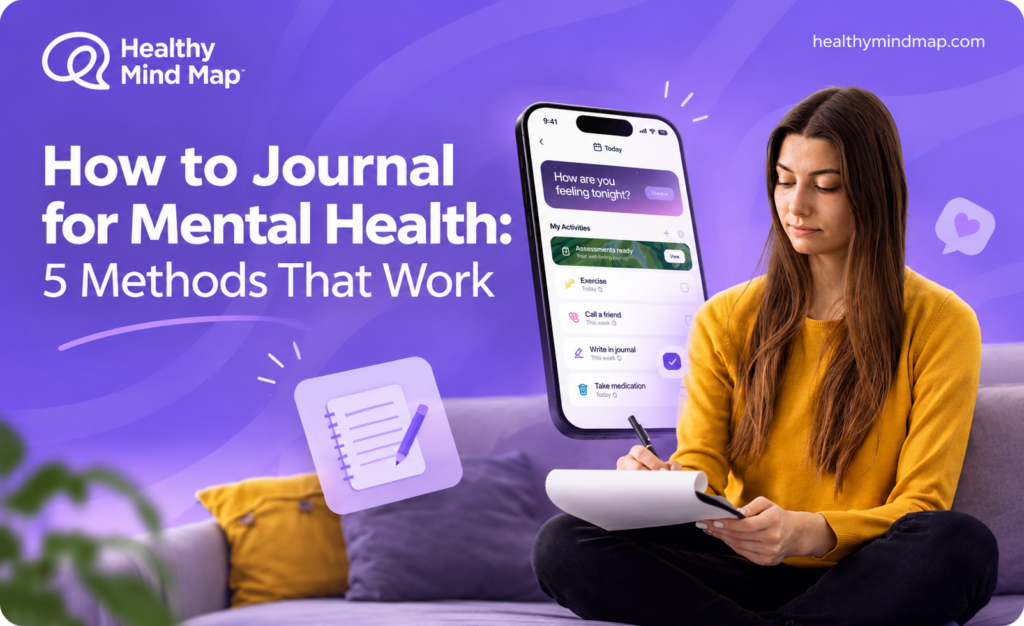


To journal for mental health, set aside 5 to 15 minutes a few times a week and write honestly about how you feel. Try one of five methods: free expressive writing, guided prompts, mood journaling, gratitude journaling, or a thought record to challenge unhelpful thoughts. There’s no right way to do it. The best method is the one that helps you feel clearer and that you’ll keep doing.
Journaling is one of the simplest tools for mental health. It’s free, private and takes only a few minutes. Yet many people stop after a few days because they don’t know what to write, or they’re not sure it’s helping.
This guide covers what journaling for mental health actually involves, five methods to try, prompts to get you started, and how to make it a habit that sticks.
Not sure what to write? Open a guided prompt and start journaling in seconds, free.
Journaling for mental health means writing about your thoughts, feelings and experiences in a way that helps you understand and process them. It’s different from keeping a diary of events. The focus is less on what happened and more on how it affected you and what you make of it.
Some journaling is open-ended, where you simply write whatever comes up. Other forms are more structured, using prompts, ratings or worksheets. Both can be helpful, depending on what you need.
Research on journaling has grown over several decades. A few findings stand out:
Journaling isn’t a replacement for professional care, but it can be a helpful daily practice alongside it.
Before picking a method, set yourself up for success:
Free writing means setting a timer and writing continuously about whatever is on your mind, especially feelings you haven’t been able to put into words. Don’t stop to edit or judge what comes out.
Best for: processing a stressful event, a difficult conversation or feelings that keep circling in your head.
Tip: If writing about something painful leaves you feeling much worse, stop and switch to something lighter. Expressive writing can stir up emotions at first, and it’s okay to go at your own pace.
If a blank page feels intimidating, prompts give you a starting point. A prompt is simply a question or statement to respond to, such as “What’s taking up most of my energy right now?”
Best for: beginners, busy days and anyone who often doesn’t know what to write.
The Healthy Mind Map app includes a Guided Journal with ready-made prompts, so you can open it and start writing without having to think of a question first.
End your day on a better note. Try the 3 Good Things Journal, free on iOS and Android.
Mood journaling combines a quick mood rating with a few lines about your day. Over time, it shows you how your mood changes and what tends to affect it.
Best for: spotting patterns and triggers, and sharing a clearer picture with a therapist.
Mood journaling overlaps with mood tracking. If you’d like to go deeper, our guide on how to track your mood covers rating scales, what to log and how to review your entries. Knowing the difference between a mood, an emotion and a feeling can also make your entries more precise.
Gratitude journaling means regularly writing down things you’re thankful for or that went well. It’s quick, and it trains your attention to notice positive moments that are easy to overlook, especially on hard days.
A popular version is the “three good things” exercise: each evening, write down three things that went well that day and why they happened. In one well-known study, people who did this for one week reported being happier and less depressed for up to six months afterward.
Best for: building a more balanced outlook, easing stress and ending the day on a calmer note.
Healthy Mind Map includes a 3 Good Things Journal built around this exercise, so you can do it in a couple of minutes before bed.
A thought record is a structured journaling tool based on cognitive behavioral therapy (CBT). It helps you slow down an upsetting thought, look at the evidence for and against it, and find a more balanced way of seeing the situation.
Best for: anxious or self-critical thoughts, overthinking and situations you keep replaying in your head.
Healthy Mind Map includes a Thought Record module that walks you through each step, which is helpful if you’re practicing CBT skills between therapy sessions.
| If you want to… | Try this method |
|---|---|
| Process a stressful event or strong feelings | Free writing |
| Start journaling but don’t know what to write | Guided prompts |
| Spot patterns in your mood and triggers | Mood journaling |
| Feel more positive and notice good moments | Gratitude journaling |
| Challenge anxious or negative thoughts | Thought record |
You don’t have to pick just one. Many people use a quick mood or gratitude entry most days and save free writing or a thought record for harder moments.
Use these to get started with guided journaling:
1. How am I feeling right now, and where do I notice it in my body? 2. What’s taking up most of my mental energy today? 3. What’s one thing I’m worried about, and what’s within my control? 4. What drained me today, and what gave me energy? 5. What would I say to a friend who felt the way I feel right now? 6. What’s one small thing I can do tomorrow to take care of myself? 7. What am I avoiding, and why? 8. What made me smile today, even briefly? 9. What’s a challenge I handled better than I expected? 10. What do I need more of this week? Less of? 11. Who made a positive difference in my day? 12. What thought keeps coming back to me, and is it completely true? 13. What am I proud of, however small? 14. What helped the last time I felt like this? 15. What do I want to remember about today?Privacy matters, because honesty is what makes journaling helpful. If you journal on paper, keep it somewhere you feel comfortable. If you use an app, choose one with a secure login.
In Healthy Mind Map, your journal sits behind a secure login, and you decide what to share and with whom. If you’re working with a therapist, you can choose to share entries or reports with them. Nothing is shared unless you choose to share it.
Journal, track your mood and practice CBT skills in one private space. Start free today.
How Often Should I Journal for Mental Health?
Three to five times a week is a good goal for most people, though even once or twice a week can be helpful. Short, regular entries tend to work better than occasional long ones.
How Long Should I Journal Each Day?
Five to fifteen minutes is plenty. Many studies on journaling used sessions of about 15 minutes. On busy days, a few sentences still count.
What Should I Write About in a Mental Health Journal?
Write about how you’re feeling, what’s on your mind, what went well, what’s been hard and what you need. If you’re stuck, use a prompt like “What’s taking up most of my energy today?”
Is It Better to Journal on Paper or in an App?
Both work. Paper can feel more personal and screen-free. An app is easier to carry with you, can remind you to write and offers guided prompts. Choose the one you’re most likely to use regularly.
Can Journaling Replace Therapy?
No. Journaling can be a helpful practice on its own or alongside therapy, but it isn’t a substitute for professional care. If you’re struggling, a therapist can offer support that journaling alone can’t.
What if Journaling Makes Me Feel Worse?
Writing about difficult feelings can sometimes stir up emotions at first. If it consistently leaves you feeling worse, switch to a lighter method like gratitude journaling, shorten your sessions, or talk to a mental health professional.



Join Healthy Mind Map today. Your first step toward understanding your mental health.