GO BACK
What Is a Daily Mood Check-In and Why Is It Useful?
Most people can tell when they are having a particularly good or difficult day, but understanding why they feel that way is


Most people can tell when they are having a particularly good or difficult day, but understanding why they feel that way is often much harder. Mood can shift because of sleep, stress, work, relationships, physical activity, daily routines, or dozens of other influences that are easy to overlook in the moment.
A daily mood check in creates a simple pause in your routine to notice what you are feeling and what may be contributing to it. Instead of waiting until stress becomes overwhelming, you develop a habit of checking in with yourself consistently.
For some people, that means using a notebook. Others prefer a daily mood checker, mood tracker, or digital platform that makes mood tracking easier to maintain. Whatever method you choose, the goal is the same: to build a clearer picture of your emotional patterns over time.
If you are already using online therapy or online counselling services, a regular daily mental health check in can also provide useful context between appointments. It may help you remember important experiences, recognize what affects your mood, and better understand whether certain coping strategies are making a difference.
So, what exactly should a daily check-in include, and why can such a small habit be useful?
A daily mood check in is a brief moment of self-reflection where you identify your current emotional state and consider what may be influencing it.
It does not need to involve a long journal entry. A simple daily mood checker might ask you to rate your mood, choose the emotions you are experiencing, and record one or two details about your day.
For example, you might record:
Over time, mood tracking turns these individual observations into patterns. A mood tracker can help you move from a vague feeling such as “I’ve been stressed lately” toward something more specific, such as “My stress tends to increase after nights when I sleep poorly.” That kind of insight is one of the primary reasons a daily mental health check in can be useful.
One reason people struggle to understand what affects your mood is that memory is imperfect. When someone has a difficult day, it can feel as though the entire week has been difficult. Similarly, after a positive day, previous stress may seem less significant than it actually was.
A mood tracker provides a more consistent record. Instead of depending entirely on memory, you can look back at your daily mood check in entries and identify recurring factors that affect mood.
These might include sleep, work pressure, social interactions, physical activity, eating patterns, hormonal changes, or environmental stress. The value of mood tracking is not simply recording emotions. It is understanding the context around them.
Many people go through an entire day without pausing to ask how they are actually feeling. A daily mental health check-in creates that pause. When you consistently identify emotions, you gradually become better at distinguishing between different experiences. Instead of describing everything as stress, you may begin recognizing frustration, disappointment, nervousness, exhaustion, loneliness, or overwhelm.
This matters because different emotions often require different responses. A daily mood checker encourages you to notice those distinctions. Over time, a mood tracker can help strengthen emotional vocabulary and self-awareness. The practice also makes tracking your mood feel less reactive. You are not waiting until something feels wrong. You are developing an everyday awareness of your emotional state.
One of the biggest benefits of tracking your mood consistently is that patterns become easier to see. Suppose you notice that your mood drops every Wednesday afternoon. Without additional context, that pattern may not mean much.
But your daily mood check in records might show that Tuesday nights consistently involve less sleep, Wednesday mornings include several stressful meetings, and you often skip lunch on those days.
Suddenly, you have several possible factors that affect mood to consider. This is why effective mood tracking often works best when emotional data is paired with information about daily habits and activities. If you want to understand what affects your mood, the surrounding context can be just as valuable as the mood rating itself.
Consistency is usually the hardest part of emotional tracking. Someone may start writing detailed journal entries but stop after a week because the process requires too much time. A simple daily mood checker removes much of that friction.
Digital tools can make tracking your mood easier by allowing you to record short check-ins quickly and review patterns later. A good mood tracker should make the process simple enough that you can maintain it even on busy days.
The objective is not to produce perfect emotional records. It is to collect enough consistent information to understand how your mood changes over time. A two-minute daily mental health check in performed regularly is often more useful than a long reflection completed only occasionally.
People receiving online therapy or in-person care often ask how to know if therapy is working. That question can be difficult because therapy progress is rarely linear.
You may still experience anxiety, sadness, stress, or difficult days even while developing healthier coping skills. That is why looking only at whether you “feel better” may not provide the full picture.
Regular mood tracking can offer additional context.
When considering how to know if therapy is working, look at whether you are recognizing triggers sooner, recovering from difficult situations faster, communicating more clearly, or using coping techniques more consistently.
A daily mood check in can help document these changes between sessions. If you use online counselling services, you may also choose to discuss relevant patterns with your provider rather than trying to remember everything that happened since your last appointment.
A daily mental health check in is not therapy, and a mood tracker cannot diagnose or treat a mental health condition. However, the information you gather may complement online therapy or online counselling services when professional support is part of your mental health plan.
For example, you might notice that certain factors that affect mood appear repeatedly. You can then decide whether those observations are worth discussing with your therapist or another qualified professional.
This is also useful when asking how to know if therapy is working. Instead of relying entirely on memory, you have a more structured record of your experiences between sessions. The important distinction is that tracking provides awareness, while professional care provides assessment, guidance, and treatment when needed.
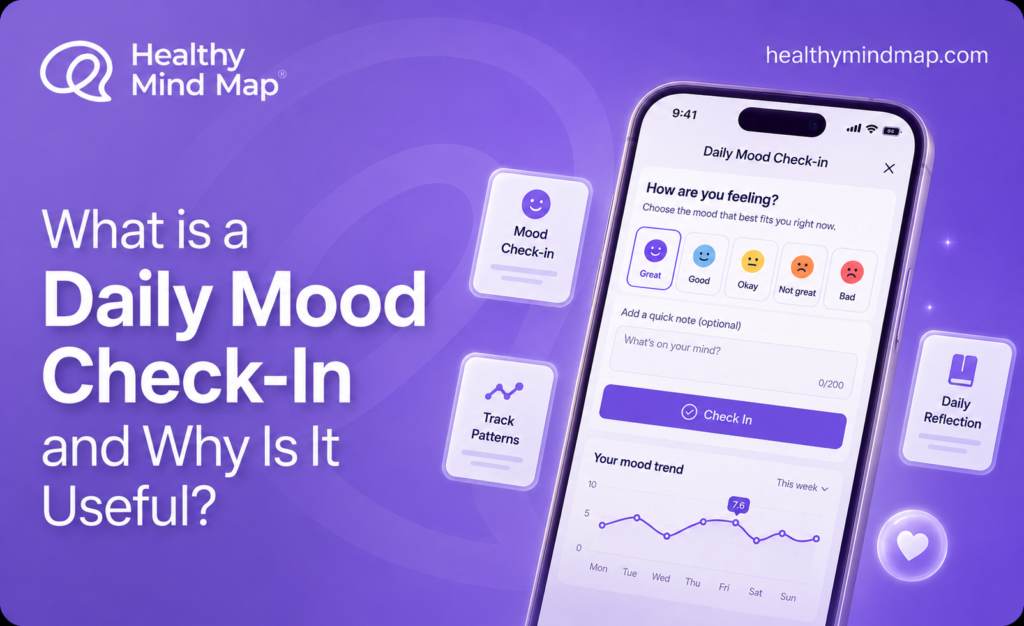
Healthy Mind Map is designed to make self-monitoring easier by combining emotional check-ins with information about daily activities and longer-term patterns. Users can complete a daily mood check in, track routines such as sleep and movement, complete progress assessments, and review analytics that show how emotional patterns change over time.
That means Healthy Mind Map goes beyond functioning as a basic daily mood checker. It helps users explore what affects your mood by connecting emotional observations with everyday behaviors.
Healthy Mind Map also provides wellness resources such as grounding exercises, breathing routines, and self-guided activities that support reflection and everyday emotional awareness.
Importantly, Healthy Mind Map does not provide online therapy or online counselling services. It is a self-guided wellness and tracking platform that can be used independently or alongside professional care.
The most useful check-in is one you can repeat consistently. You do not need to track everything. Start with a few categories that matter to you.
A practical daily mental health check in might include your overall mood, stress level, sleep quality, energy, and one important event from the day. You can also note activities such as exercise, mindfulness, social interaction, or self-care.
After several weeks of tracking your mood, review what you have collected. Which days tend to feel better? Which factors that affect mood repeatedly appear before difficult days? What routines seem connected to improved emotional balance? This is where a simple mood tracker becomes genuinely useful.
A daily check-in may seem like a small habit, but consistent reflection can reveal information that is difficult to notice from memory alone. By completing a daily mood check in, using a daily mood checker, and consistently tracking your mood, you create a clearer record of how your emotional state changes and which factors that affect mood may be influencing those changes.
For people receiving online therapy or online counselling services, those observations can also make it easier to discuss experiences between appointments and evaluate how to know if therapy is working over time. Healthy Mind Map provides a structured way to build that awareness through emotional check-ins, activity tracking, assessments, and analytics.
Sometimes understanding your emotional health starts with a very simple habit: taking a moment each day to notice how you’re actually doing.
What is a daily mood check in?
A daily mood check in is a short self-reflection where you record your emotional state and consider what may have influenced it. Using a daily mood checker regularly can make emotional patterns easier to identify over time.
Why is mood tracking useful?
Mood tracking helps individuals recognize recurring patterns, identify what affects your mood, and understand how habits, stress, relationships, and daily experiences may influence emotional well-being.
What should I track in a daily mental health check in?
A daily mental health check in can include mood, stress, sleep, energy, major events, and relevant daily habits. The goal is to identify the factors that affect mood without making the process unnecessarily complicated.
Can a mood tracker help me know if therapy is working?
A mood tracker can provide useful context when you’re asking how to know if therapy is working. It may help you recognize gradual changes in mood, coping, triggers, and recovery between online therapy or in-person sessions.
Can Healthy Mind Map replace online counselling services?
No. Healthy Mind Map supports self-guided mood tracking, activity awareness, assessments, and emotional reflection. It does not provide online counselling services or replace professional mental health treatment.



Join Healthy Mind Map today. Your first step toward understanding your mental health.